Tag: exam preparation

  • Exam Countdown Timers: Why Tracking Your Days Left Boosts Study Productivity

    Exam Countdown Timers: Why Tracking Your Days Left Boosts Study Productivity

    Every student knows the feeling: the exam date seems comfortably far away, until suddenly it isn’t. The gap between “I have plenty of time” and “I’m running out of days” can shrink overnight, often leaving revision plans in chaos. This is where a simple but powerful tool comes into play—the exam countdown timer. By translating a vague future date into a concrete, ticking number of days, a countdown transforms abstract anxiety into focused action. In this article, we’ll explore why tracking your days left genuinely boosts study productivity, and how you can build a countdown-based revision schedule that keeps you on track from start to finish.

    What Is an Exam Countdown Timer?

    An exam countdown timer is a tool that displays the exact amount of time remaining until your test day. It can show days, hours, and even minutes, updating in real time. Whether it’s a widget on your phone, a browser tab, or a dedicated online tool, its job is simple: keep the deadline visible and unavoidable. For students preparing for government exams, competitive tests, or university finals, this constant visual reminder is surprisingly effective at shaping daily behavior.

    The Psychology Behind Countdown Timers

    Countdown timers work because they tap into well-documented psychological principles. Understanding these can help you use the tool more intentionally.

    1. They Create a Sense of Urgency

    Deadlines drive action. When a date is far away, our brains treat it as a low priority. But when we see “27 days remaining,” the abstract becomes real. This urgency counteracts procrastination, nudging you to start studying today rather than “tomorrow.”

    2. They Combat the Planning Fallacy

    Most students underestimate how long revision actually takes. A countdown provides an honest, unblinking measure of reality. Seeing the number drop each day forces you to confront whether your current pace matches the time you have left.

    3. They Provide Structure and Motivation

    A visible countdown acts as a psychological anchor. It reminds you why you’re studying and gives each day a purpose. Instead of studying aimlessly, you begin to think in terms of “What must I accomplish in these remaining days?”

    How Tracking Days Left Boosts Productivity

    Beyond the mental effects, countdown timers deliver practical productivity gains. Here’s how tracking your time transforms your study routine.

    • Better prioritization: With limited days visible, you naturally focus on high-yield topics first instead of getting lost in minor details.
    • Reduced procrastination: A shrinking number is harder to ignore than a distant date circled on a calendar.
    • Consistent daily effort: Seeing the countdown daily encourages regular, incremental study rather than last-minute cramming.
    • Measurable progress: You can align syllabus coverage with days remaining, making it easy to see if you’re ahead or behind.
    • Lower anxiety through control: Ironically, knowing exactly how much time you have—rather than guessing—reduces stress by replacing uncertainty with a plan.

    Building a Countdown-Based Revision Schedule

    A countdown is most powerful when paired with a structured plan. Here’s a step-by-step approach to building a revision schedule around your remaining days.

    Step 1: Set Your Countdown

    Start by entering your exam date into a reliable countdown tool. Keep it somewhere you’ll see it constantly—your phone home screen, browser homepage, or a sticky note referencing the number. The goal is visibility.

    Step 2: Break the Syllabus Into Chunks

    List every subject and topic you need to cover. Divide the material into manageable units. If you have 40 days and 20 topics, you immediately know you have roughly two days per topic—plus buffer time for revision.

    Step 3: Work Backwards From the Exam

    Reverse-engineer your schedule. Reserve the final 5–7 days exclusively for revision, mock tests, and weak-area reinforcement. Then allocate the remaining days to fresh learning. This ensures you don’t reach the last week with unlearned material.

    Step 4: Assign Daily Targets

    Break each study block into daily goals tied to the countdown. For example:

    • Days 40–30: Cover core theory and build strong foundations.
    • Days 29–15: Complete remaining topics and start practice questions.
    • Days 14–7: Take full-length mock tests and review mistakes.
    • Days 6–1: Revise notes, focus on weak spots, and rest adequately.

    Step 5: Review and Adjust Regularly

    Each week, check the countdown against your progress. If you’re falling behind, reallocate time, trim low-priority topics, or increase daily study hours. The countdown makes these adjustments obvious and timely.

    Pairing Countdown Timers With Other Study Tools

    A countdown works even better as part of a broader toolkit. Consider combining it with:

    • Age calculators: Useful for confirming eligibility criteria for government and competitive exams before you invest weeks of preparation.
    • Image resizing and cropping tools: Many exam applications require photos and signatures in specific dimensions—resizing and cropping tools help you meet these requirements without rejection.
    • Signature crop tools: Formatting your signature correctly for online forms saves last-minute stress during application submission.
    • Task and habit trackers: These complement the countdown by logging what you actually accomplished each day.

    Together, these tools handle both your preparation and the administrative side of exams, so nothing slips through the cracks as the big day approaches.

    Tips to Make the Most of Your Countdown

    • Keep it visible, not stressful: Use the countdown as a motivator, not a source of panic. Frame it as “days to prepare,” not “days until doom.”
    • Celebrate milestones: Reward yourself when you hit key markers, like completing the syllabus or crossing the halfway point.
    • Build in rest days: A sustainable schedule includes breaks. Burning out at day 20 helps no one.
    • Pair numbers with action: Every time you glance at the countdown, ask, “What’s my one priority today?”

    Conclusion

    An exam countdown timer is more than a ticking clock—it’s a productivity engine. By making time visible, it creates urgency, encourages consistent effort, and gives structure to your revision. When combined with a reverse-engineered study schedule and supporting tools like age calculators and image resizers, a countdown helps you approach exam day with confidence rather than chaos. Set your countdown today, plan backwards from your target, and let each passing day push you one step closer to success. Your future self, sitting calmly in the exam hall, will thank you.

  • Exam Countdown Timers: Why Tracking Your Days Left Boosts Study Productivity

    Exam Countdown Timers: Why Tracking Your Days Left Boosts Study Productivity

    Every student knows the feeling: the exam date seems comfortably far away, until suddenly it isn’t. The gap between “I have plenty of time” and “I’m running out of days” can shrink overnight, often leaving revision plans in chaos. This is where a simple but powerful tool comes into play—the exam countdown timer. By translating a vague future date into a concrete, ticking number of days, a countdown transforms abstract anxiety into focused action. In this article, we’ll explore why tracking your days left genuinely boosts study productivity, and how you can build a countdown-based revision schedule that keeps you on track from start to finish.

    What Is an Exam Countdown Timer?

    An exam countdown timer is a tool that displays the exact amount of time remaining until your test day. It can show days, hours, and even minutes, updating in real time. Whether it’s a widget on your phone, a browser tab, or a dedicated online tool, its job is simple: keep the deadline visible and unavoidable. For students preparing for government exams, competitive tests, or university finals, this constant visual reminder is surprisingly effective at shaping daily behavior.

    The Psychology Behind Countdown Timers

    Countdown timers work because they tap into well-documented psychological principles. Understanding these can help you use the tool more intentionally.

    1. They Create a Sense of Urgency

    Deadlines drive action. When a date is far away, our brains treat it as a low priority. But when we see “27 days remaining,” the abstract becomes real. This urgency counteracts procrastination, nudging you to start studying today rather than “tomorrow.”

    2. They Combat the Planning Fallacy

    Most students underestimate how long revision actually takes. A countdown provides an honest, unblinking measure of reality. Seeing the number drop each day forces you to confront whether your current pace matches the time you have left.

    3. They Provide Structure and Motivation

    A visible countdown acts as a psychological anchor. It reminds you why you’re studying and gives each day a purpose. Instead of studying aimlessly, you begin to think in terms of “What must I accomplish in these remaining days?”

    How Tracking Days Left Boosts Productivity

    Beyond the mental effects, countdown timers deliver practical productivity gains. Here’s how tracking your time transforms your study routine.

    • Better prioritization: With limited days visible, you naturally focus on high-yield topics first instead of getting lost in minor details.
    • Reduced procrastination: A shrinking number is harder to ignore than a distant date circled on a calendar.
    • Consistent daily effort: Seeing the countdown daily encourages regular, incremental study rather than last-minute cramming.
    • Measurable progress: You can align syllabus coverage with days remaining, making it easy to see if you’re ahead or behind.
    • Lower anxiety through control: Ironically, knowing exactly how much time you have—rather than guessing—reduces stress by replacing uncertainty with a plan.

    Building a Countdown-Based Revision Schedule

    A countdown is most powerful when paired with a structured plan. Here’s a step-by-step approach to building a revision schedule around your remaining days.

    Step 1: Set Your Countdown

    Start by entering your exam date into a reliable countdown tool. Keep it somewhere you’ll see it constantly—your phone home screen, browser homepage, or a sticky note referencing the number. The goal is visibility.

    Step 2: Break the Syllabus Into Chunks

    List every subject and topic you need to cover. Divide the material into manageable units. If you have 40 days and 20 topics, you immediately know you have roughly two days per topic—plus buffer time for revision.

    Step 3: Work Backwards From the Exam

    Reverse-engineer your schedule. Reserve the final 5–7 days exclusively for revision, mock tests, and weak-area reinforcement. Then allocate the remaining days to fresh learning. This ensures you don’t reach the last week with unlearned material.

    Step 4: Assign Daily Targets

    Break each study block into daily goals tied to the countdown. For example:

    • Days 40–30: Cover core theory and build strong foundations.
    • Days 29–15: Complete remaining topics and start practice questions.
    • Days 14–7: Take full-length mock tests and review mistakes.
    • Days 6–1: Revise notes, focus on weak spots, and rest adequately.

    Step 5: Review and Adjust Regularly

    Each week, check the countdown against your progress. If you’re falling behind, reallocate time, trim low-priority topics, or increase daily study hours. The countdown makes these adjustments obvious and timely.

    Pairing Countdown Timers With Other Study Tools

    A countdown works even better as part of a broader toolkit. Consider combining it with:

    • Age calculators: Useful for confirming eligibility criteria for government and competitive exams before you invest weeks of preparation.
    • Image resizing and cropping tools: Many exam applications require photos and signatures in specific dimensions—resizing and cropping tools help you meet these requirements without rejection.
    • Signature crop tools: Formatting your signature correctly for online forms saves last-minute stress during application submission.
    • Task and habit trackers: These complement the countdown by logging what you actually accomplished each day.

    Together, these tools handle both your preparation and the administrative side of exams, so nothing slips through the cracks as the big day approaches.

    Tips to Make the Most of Your Countdown

    • Keep it visible, not stressful: Use the countdown as a motivator, not a source of panic. Frame it as “days to prepare,” not “days until doom.”
    • Celebrate milestones: Reward yourself when you hit key markers, like completing the syllabus or crossing the halfway point.
    • Build in rest days: A sustainable schedule includes breaks. Burning out at day 20 helps no one.
    • Pair numbers with action: Every time you glance at the countdown, ask, “What’s my one priority today?”

    Conclusion

    An exam countdown timer is more than a ticking clock—it’s a productivity engine. By making time visible, it creates urgency, encourages consistent effort, and gives structure to your revision. When combined with a reverse-engineered study schedule and supporting tools like age calculators and image resizers, a countdown helps you approach exam day with confidence rather than chaos. Set your countdown today, plan backwards from your target, and let each passing day push you one step closer to success. Your future self, sitting calmly in the exam hall, will thank you.

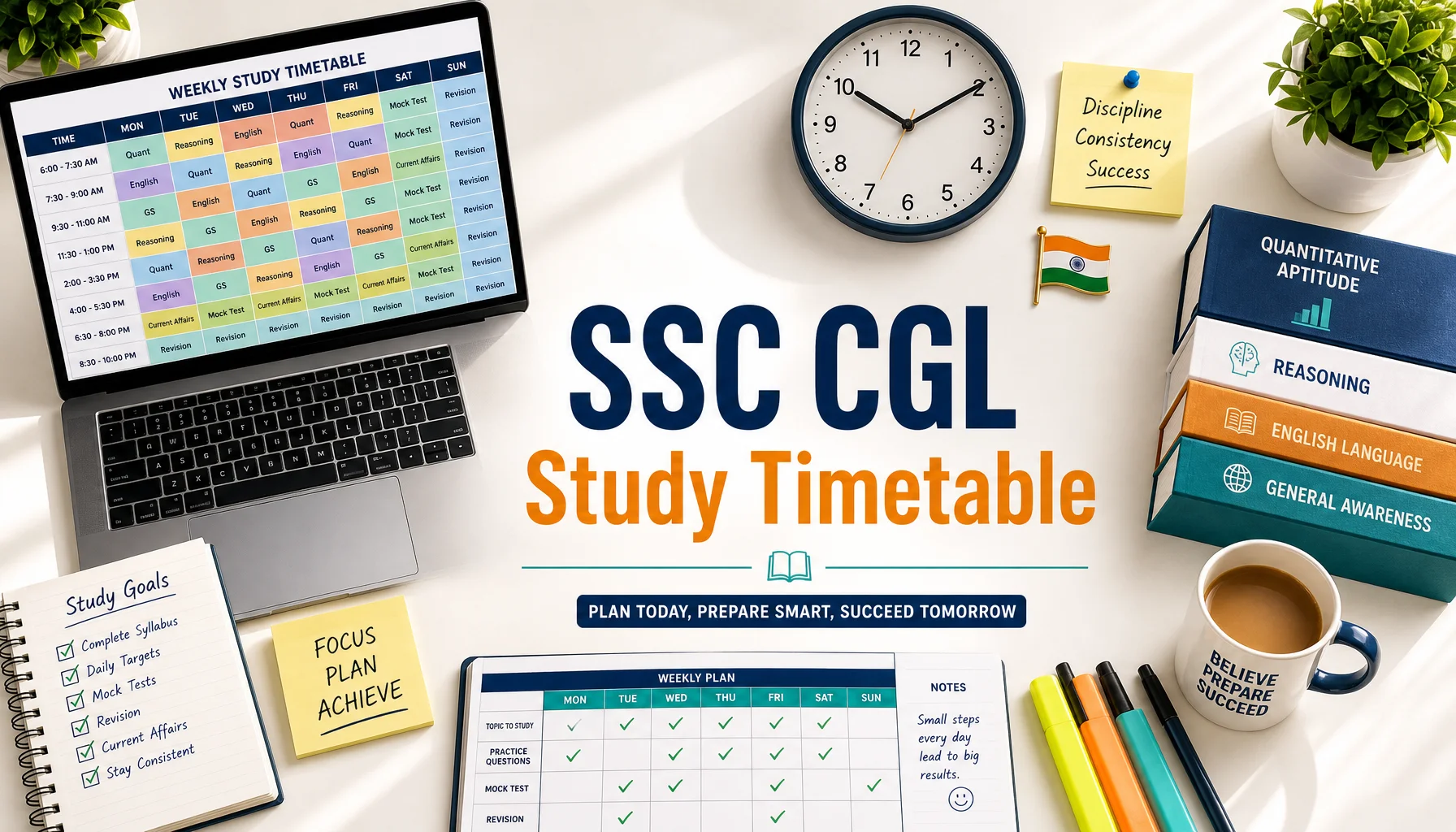
  • How to Create a Winning SSC CGL Study Timetable for Online Learners

    How to Create a Winning SSC CGL Study Timetable for Online Learners

    Preparing for the SSC CGL exam from the comfort of your home offers incredible flexibility, but it also demands serious self-discipline. Without a structured plan, online learners often find themselves jumping between topics, over-studying their favorite section, and neglecting weaker areas. The secret to consistent progress isn’t just working hard—it’s working smart with a well-designed study timetable. In this guide, we’ll walk you through practical scheduling strategies and share sample daily and weekly plans to help you balance all four sections of the SSC CGL exam while studying online.

    Why a Timetable Matters for Online SSC CGL Preparation

    When you’re studying at home, the boundaries between study time and leisure time blur easily. A timetable transforms vague intentions into concrete commitments. For SSC CGL aspirants specifically, a schedule ensures you give proportionate attention to all four sections:

    • General Intelligence & Reasoning
    • General Awareness
    • Quantitative Aptitude
    • English Comprehension

    Neglecting even one section can pull down your overall score, since each carries equal weight in Tier 1. A balanced timetable prevents this imbalance and keeps you accountable.

    Step 1: Assess Your Starting Point

    Before building any schedule, take a diagnostic mock test. This helps you identify which sections are your strengths and which need extra hours. For example, if your Quantitative Aptitude score is weak, you’ll want to allocate more daily time there while still maintaining momentum in your stronger areas.

    Divide your subjects into three tiers:

    • Weak areas — need the most practice and revision time.
    • Moderate areas — need steady, regular attention.
    • Strong areas — need maintenance and periodic revision.

    Step 2: Determine Your Available Study Hours

    Be honest about how many hours you can realistically dedicate each day. Full-time aspirants might manage 6–8 hours, while working professionals or college students may only have 3–4 hours. Quality beats quantity—four focused hours will outperform eight distracted ones.

    Break your available time into study blocks of 45–60 minutes, followed by short breaks. This technique, similar to the Pomodoro method, keeps your mind fresh and prevents burnout during long home study sessions.

    Step 3: Follow the Rotation Principle

    One of the biggest mistakes online learners make is studying only one subject per day. Instead, cover at least two to three sections daily. This rotation keeps every subject active in your memory and prevents the “cold start” problem where you forget concepts you haven’t touched in days.

    A good rule of thumb is to pair a calculation-heavy subject (Quant) with a memory-based one (General Awareness) and a logic-based one (Reasoning), rotating English throughout the week.

    Sample Daily Timetable for Full-Time Aspirants

    Here’s a sample plan for someone with 6–7 hours available:

    • 7:00 – 8:30 AM: Quantitative Aptitude (concept learning + practice)
    • 8:30 – 9:00 AM: Break
    • 9:00 – 10:30 AM: Reasoning (topic practice + puzzles)
    • 10:30 – 11:00 AM: Short revision of yesterday’s topics
    • 11:00 – 12:00 PM: English (grammar rules or vocabulary)
    • Afternoon rest / light activity
    • 4:00 – 5:00 PM: General Awareness + daily current affairs
    • 5:00 – 6:00 PM: Sectional or full mock test practice
    • 9:00 – 9:30 PM: Analysis of the day’s mistakes and notes review

    Sample Daily Timetable for Working Professionals

    If you have limited hours, focus on consistency and micro-learning throughout the day:

    • Early morning (1 hour): Quantitative Aptitude practice
    • Commute / lunch break: Vocabulary flashcards and current affairs via mobile apps
    • Evening (1.5 hours): Reasoning and English alternately on different days
    • Night (30 minutes): Revision and short quizzes

    Reserve weekends for longer sessions, full-length mock tests, and detailed performance analysis.

    Sample Weekly Plan

    A weekly view ensures balanced coverage across all sections. Here’s how you might distribute focus:

    • Monday: Quant (Arithmetic) + Reasoning + English (Grammar)
    • Tuesday: Quant (Advanced Maths) + General Awareness + Vocabulary
    • Wednesday: Reasoning (Non-verbal) + English (Comprehension) + Quant revision
    • Thursday: Quant (Data Interpretation) + General Awareness + Reasoning
    • Friday: English (Error Spotting) + Reasoning + Quant practice
    • Saturday: Full-length mock test + detailed analysis
    • Sunday: Weekly revision + weak-area focus + rest

    Notice how current affairs and General Awareness appear on multiple days—this section rewards daily consistency more than any other.

    Step 4: Build In Mock Tests and Analysis

    Online learners have a huge advantage: unlimited access to digital mock tests. Schedule at least two to three sectional tests during the week and one full-length mock on the weekend. But taking the test is only half the work. Spend equal time analyzing your errors, understanding why you got questions wrong, and updating your notes. This feedback loop is what turns practice into improvement.

    Step 5: Make It Sustainable

    The best timetable is the one you can actually follow long-term. Keep these tips in mind:

    • Include buffer time for topics that take longer than expected.
    • Schedule one lighter day each week to avoid burnout.
    • Track your progress using a simple diary or spreadsheet.
    • Eliminate distractions by keeping your phone in another room during focused blocks.
    • Review and adjust your plan every two weeks based on mock test results.

    Common Timetable Mistakes to Avoid

    As you design your schedule, watch out for these pitfalls:

    • Over-scheduling with unrealistic hours that lead to guilt and quitting.
    • Ignoring revision—new topics won’t stick without regular review.
    • Studying only strong subjects because they feel rewarding.
    • Skipping breaks, which reduces concentration and retention.

    Conclusion

    Creating a winning SSC CGL study timetable is about balance, consistency, and honest self-assessment. As an online learner, you have the freedom to design a schedule that fits your life—use that flexibility wisely. Start by understanding your strengths and weaknesses, rotate your subjects daily, integrate regular mock tests, and always leave room for revision. Remember, the perfect timetable isn’t the most intense one; it’s the one you can follow every single day until exam day. Build your plan today, stay disciplined, and watch your preparation transform into results.