Tag: competitive exams

  • How to Create a Winning SSC CGL Study Timetable for Online Learners

    How to Create a Winning SSC CGL Study Timetable for Online Learners

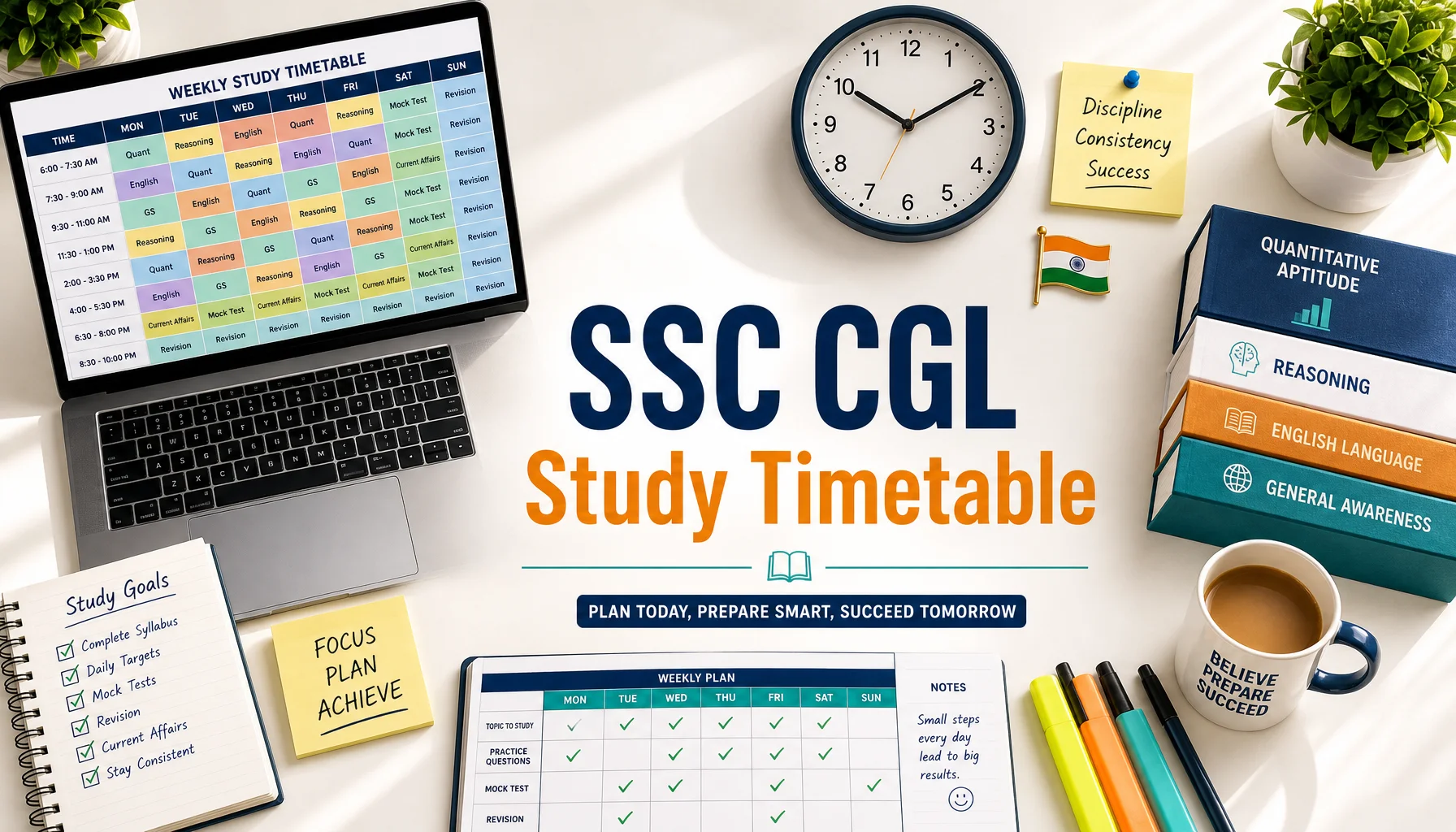
    Preparing for the SSC CGL exam from the comfort of your home offers incredible flexibility, but it also demands serious self-discipline. Without a structured plan, online learners often find themselves jumping between topics, over-studying their favorite section, and neglecting weaker areas. The secret to consistent progress isn’t just working hard—it’s working smart with a well-designed study timetable. In this guide, we’ll walk you through practical scheduling strategies and share sample daily and weekly plans to help you balance all four sections of the SSC CGL exam while studying online.

    Why a Timetable Matters for Online SSC CGL Preparation

    When you’re studying at home, the boundaries between study time and leisure time blur easily. A timetable transforms vague intentions into concrete commitments. For SSC CGL aspirants specifically, a schedule ensures you give proportionate attention to all four sections:

    • General Intelligence & Reasoning
    • General Awareness
    • Quantitative Aptitude
    • English Comprehension

    Neglecting even one section can pull down your overall score, since each carries equal weight in Tier 1. A balanced timetable prevents this imbalance and keeps you accountable.

    Step 1: Assess Your Starting Point

    Before building any schedule, take a diagnostic mock test. This helps you identify which sections are your strengths and which need extra hours. For example, if your Quantitative Aptitude score is weak, you’ll want to allocate more daily time there while still maintaining momentum in your stronger areas.

    Divide your subjects into three tiers:

    • Weak areas — need the most practice and revision time.
    • Moderate areas — need steady, regular attention.
    • Strong areas — need maintenance and periodic revision.

    Step 2: Determine Your Available Study Hours

    Be honest about how many hours you can realistically dedicate each day. Full-time aspirants might manage 6–8 hours, while working professionals or college students may only have 3–4 hours. Quality beats quantity—four focused hours will outperform eight distracted ones.

    Break your available time into study blocks of 45–60 minutes, followed by short breaks. This technique, similar to the Pomodoro method, keeps your mind fresh and prevents burnout during long home study sessions.

    Step 3: Follow the Rotation Principle

    One of the biggest mistakes online learners make is studying only one subject per day. Instead, cover at least two to three sections daily. This rotation keeps every subject active in your memory and prevents the “cold start” problem where you forget concepts you haven’t touched in days.

    A good rule of thumb is to pair a calculation-heavy subject (Quant) with a memory-based one (General Awareness) and a logic-based one (Reasoning), rotating English throughout the week.

    Sample Daily Timetable for Full-Time Aspirants

    Here’s a sample plan for someone with 6–7 hours available:

    • 7:00 – 8:30 AM: Quantitative Aptitude (concept learning + practice)
    • 8:30 – 9:00 AM: Break
    • 9:00 – 10:30 AM: Reasoning (topic practice + puzzles)
    • 10:30 – 11:00 AM: Short revision of yesterday’s topics
    • 11:00 – 12:00 PM: English (grammar rules or vocabulary)
    • Afternoon rest / light activity
    • 4:00 – 5:00 PM: General Awareness + daily current affairs
    • 5:00 – 6:00 PM: Sectional or full mock test practice
    • 9:00 – 9:30 PM: Analysis of the day’s mistakes and notes review

    Sample Daily Timetable for Working Professionals

    If you have limited hours, focus on consistency and micro-learning throughout the day:

    • Early morning (1 hour): Quantitative Aptitude practice
    • Commute / lunch break: Vocabulary flashcards and current affairs via mobile apps
    • Evening (1.5 hours): Reasoning and English alternately on different days
    • Night (30 minutes): Revision and short quizzes

    Reserve weekends for longer sessions, full-length mock tests, and detailed performance analysis.

    Sample Weekly Plan

    A weekly view ensures balanced coverage across all sections. Here’s how you might distribute focus:

    • Monday: Quant (Arithmetic) + Reasoning + English (Grammar)
    • Tuesday: Quant (Advanced Maths) + General Awareness + Vocabulary
    • Wednesday: Reasoning (Non-verbal) + English (Comprehension) + Quant revision
    • Thursday: Quant (Data Interpretation) + General Awareness + Reasoning
    • Friday: English (Error Spotting) + Reasoning + Quant practice
    • Saturday: Full-length mock test + detailed analysis
    • Sunday: Weekly revision + weak-area focus + rest

    Notice how current affairs and General Awareness appear on multiple days—this section rewards daily consistency more than any other.

    Step 4: Build In Mock Tests and Analysis

    Online learners have a huge advantage: unlimited access to digital mock tests. Schedule at least two to three sectional tests during the week and one full-length mock on the weekend. But taking the test is only half the work. Spend equal time analyzing your errors, understanding why you got questions wrong, and updating your notes. This feedback loop is what turns practice into improvement.

    Step 5: Make It Sustainable

    The best timetable is the one you can actually follow long-term. Keep these tips in mind:

    • Include buffer time for topics that take longer than expected.
    • Schedule one lighter day each week to avoid burnout.
    • Track your progress using a simple diary or spreadsheet.
    • Eliminate distractions by keeping your phone in another room during focused blocks.
    • Review and adjust your plan every two weeks based on mock test results.

    Common Timetable Mistakes to Avoid

    As you design your schedule, watch out for these pitfalls:

    • Over-scheduling with unrealistic hours that lead to guilt and quitting.
    • Ignoring revision—new topics won’t stick without regular review.
    • Studying only strong subjects because they feel rewarding.
    • Skipping breaks, which reduces concentration and retention.

    Conclusion

    Creating a winning SSC CGL study timetable is about balance, consistency, and honest self-assessment. As an online learner, you have the freedom to design a schedule that fits your life—use that flexibility wisely. Start by understanding your strengths and weaknesses, rotate your subjects daily, integrate regular mock tests, and always leave room for revision. Remember, the perfect timetable isn’t the most intense one; it’s the one you can follow every single day until exam day. Build your plan today, stay disciplined, and watch your preparation transform into results.
  • 7 Common Mistakes Students Make in Current Affairs Prep (And How to Fix Them)

    7 Common Mistakes Students Make in Current Affairs Prep (And How to Fix Them)

    Current affairs preparation feels deceptively simple. Read the news, remember the facts, answer the questions—how hard can it be? Yet every exam season, thousands of aspirants who spend hours scrolling through headlines still fumble on questions they “definitely read somewhere.” The problem is rarely a lack of effort. It’s a collection of small, invisible habits that quietly sabotage retention and recall. In this guide, we’ll dissect seven of the most common mistakes students make in current affairs prep and, more importantly, give you a concrete fix for each one.

    1. Over-Relying on Random Apps and Feeds

    The modern aspirant is spoiled for choice. There are dozens of apps pushing daily current affairs, YouTube channels summarizing the week, and Telegram groups flooding your phone with PDFs. The trouble is that consuming ten different sources doesn’t equal ten times the knowledge—it usually creates ten times the confusion.

    When you hop between unstructured feeds, you get overlapping information, contradictory facts, and no sense of what actually matters for your exam. You feel busy, but you’re not building a coherent knowledge base.

    The fix:

    • Pick one primary source (a reliable newspaper or a single trusted monthly compilation) and treat everything else as supplementary.
    • Choose a secondary source only for cross-verification, not for volume.
    • Filter content through the lens of your specific exam syllabus—if it’s unlikely to be asked, let it go.

    2. Passive Reading Without Note-Making mock test

    Reading an article and nodding along creates a dangerous illusion of learning. You recognize the information, so your brain assumes you’ve absorbed it. But recognition is not recall. Come exam day, you can’t reproduce what you never actively processed.

    The fix: Convert passive reading into active engagement. After reading a news item, write a one-line summary in your own words. Maintain a running notebook or digital document organized by theme—polity, economy, international relations, science, sports, and so on. The act of rephrasing and categorizing forces your brain to encode the information properly.

    3. Ignoring the “Why” Behind the News

    Many students memorize isolated facts: a summit was held, a scheme was launched, a rate was changed. But current affairs questions increasingly test understanding, not just memory. If you don’t know why an event matters or how it connects to broader concepts, you’ll struggle with analytical questions.

    The fix: For every important news item, ask yourself three questions:

    • What is the background or context that led to this?
    • Why is it significant—politically, economically, or socially?
    • What might be its consequences or follow-up developments?

    This habit transforms scattered headlines into a connected web of understanding that sticks far longer than rote facts.

    4. Skipping Revision Entirely

    This is the single most damaging mistake, and almost everyone is guilty of it. Aspirants read new content every single day but rarely circle back to what they studied last week or last month. The human brain forgets roughly 70% of new information within a few days without reinforcement—a phenomenon known as the forgetting curve.

    The fix: Build revision directly into your routine using spaced repetition:

    • Revise daily notes at the end of each day (5–10 minutes).
    • Do a weekly consolidation every Sunday.
    • Complete a monthly review using compilations or your own notes.

    Treat revision as non-negotiable. It’s better to read less new material and revise thoroughly than to consume everything and retain nothing.

    5. Neglecting Practice Quizzes

    Reading builds input; quizzing tests output. Students who only read but never test themselves have no idea where their gaps are. They discover their weaknesses in the actual exam—the worst possible time.

    The fix: Make quizzing a daily habit. Attempt current affairs MCQs regularly, ideally covering the past week’s events. When you get a question wrong, don’t just note the correct answer—go back to the source, understand why you erred, and add that point to your revision notes. Quizzes also train you to handle the pressure and format of real exam questions, improving both speed and accuracy.

    Turn Mistakes into Study Material

    Keep a dedicated “error log” of every question you get wrong. Reviewing this log before the exam is one of the highest-return activities in your entire prep, because it targets your personal weak spots rather than generic content.

    6. Cramming Static and Dynamic Content Separately

    Current affairs rarely exist in a vacuum. A news story about a river dispute connects to geography; a policy announcement links to constitutional provisions; an economic report ties into core economic concepts. Students who study current affairs in complete isolation from static subjects miss these crucial linkages.

    The fix: Whenever a news item touches a static topic, take a moment to revise the related fundamentals. Reading about a Supreme Court verdict? Quickly review the relevant articles of the Constitution. Studying a new space mission? Refresh the basic science behind it. This integrated approach strengthens both your static and dynamic preparation simultaneously.

    7. Starting Too Late and Panicking

    Some aspirants ignore current affairs for months, assuming they’ll “catch up” before the exam. Then they face a mountain of a year’s worth of events and try to cram it in a few weeks—a recipe for stress and shallow learning.

    The fix: Current affairs is a marathon, not a sprint. Start early and stay consistent, even if it’s just 20–30 focused minutes a day. Consistency beats intensity. A student who does a little every day will always outperform one who binges in a panic. If you’re starting late, don’t try to cover everything—prioritize the most exam-relevant months and high-yield topics.

    Conclusion

    Notice that none of these mistakes involve a lack of intelligence or effort. They’re all about method. The students who excel at current affairs aren’t necessarily reading more—they’re reading smarter: one trusted source, active notes, contextual understanding, relentless revision, regular quizzing, integrated static linkage, and early consistency. Audit your own prep against this list, fix the leaks you find, and you’ll notice your scores climb steadily. Current affairs rewards discipline over drama—so start today, stay consistent, and let the results follow.