Tag: ap government jobs

  • How to Create a Winning SSC CGL Study Timetable for Online Learners

    How to Create a Winning SSC CGL Study Timetable for Online Learners

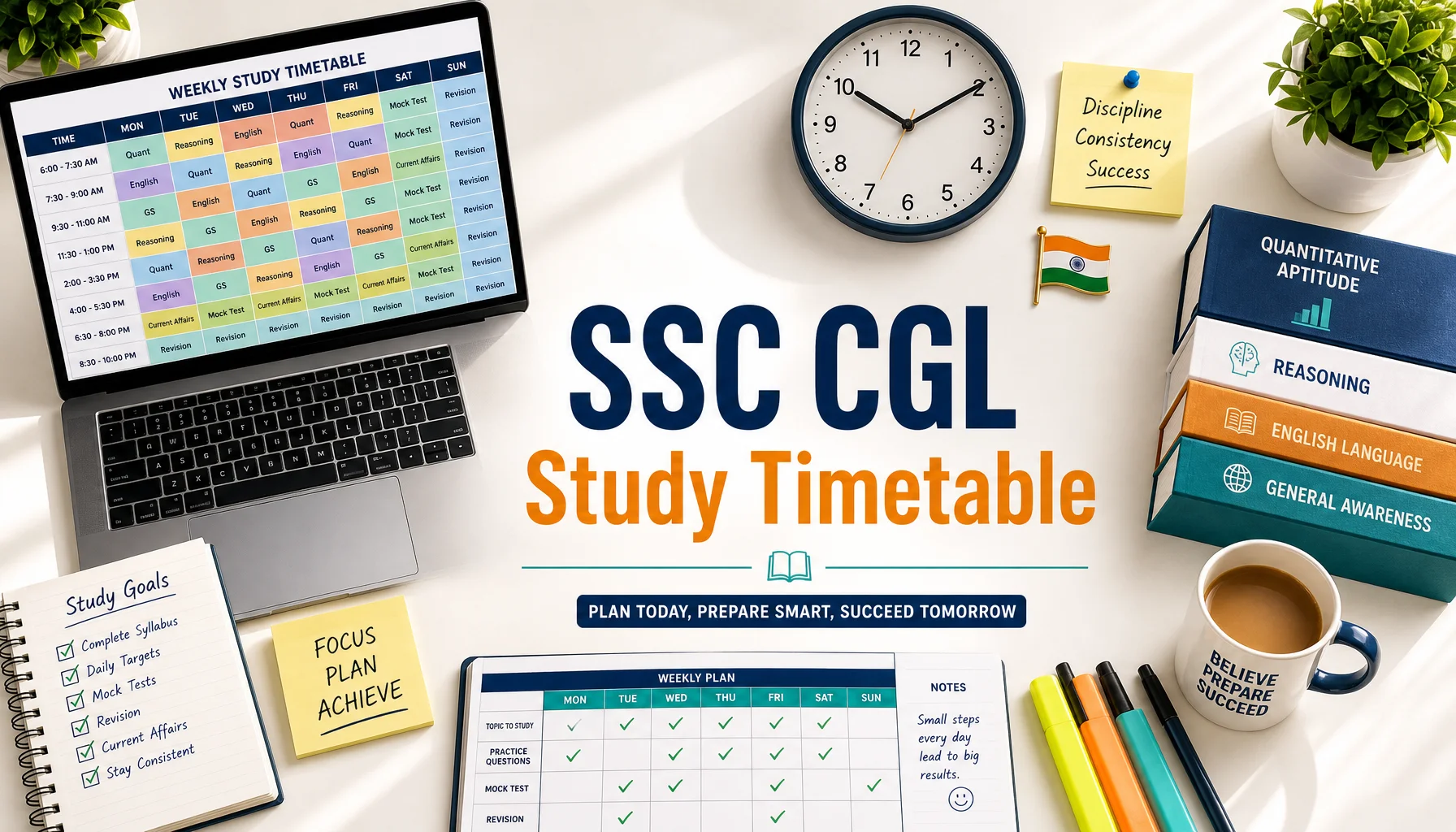
    Preparing for the SSC CGL exam from the comfort of your home offers incredible flexibility, but it also demands serious self-discipline. Without a structured plan, online learners often find themselves jumping between topics, over-studying their favorite section, and neglecting weaker areas. The secret to consistent progress isn’t just working hard—it’s working smart with a well-designed study timetable. In this guide, we’ll walk you through practical scheduling strategies and share sample daily and weekly plans to help you balance all four sections of the SSC CGL exam while studying online.

    Why a Timetable Matters for Online SSC CGL Preparation

    When you’re studying at home, the boundaries between study time and leisure time blur easily. A timetable transforms vague intentions into concrete commitments. For SSC CGL aspirants specifically, a schedule ensures you give proportionate attention to all four sections:

    • General Intelligence & Reasoning
    • General Awareness
    • Quantitative Aptitude
    • English Comprehension

    Neglecting even one section can pull down your overall score, since each carries equal weight in Tier 1. A balanced timetable prevents this imbalance and keeps you accountable.

    Step 1: Assess Your Starting Point

    Before building any schedule, take a diagnostic mock test. This helps you identify which sections are your strengths and which need extra hours. For example, if your Quantitative Aptitude score is weak, you’ll want to allocate more daily time there while still maintaining momentum in your stronger areas.

    Divide your subjects into three tiers:

    • Weak areas — need the most practice and revision time.
    • Moderate areas — need steady, regular attention.
    • Strong areas — need maintenance and periodic revision.

    Step 2: Determine Your Available Study Hours

    Be honest about how many hours you can realistically dedicate each day. Full-time aspirants might manage 6–8 hours, while working professionals or college students may only have 3–4 hours. Quality beats quantity—four focused hours will outperform eight distracted ones.

    Break your available time into study blocks of 45–60 minutes, followed by short breaks. This technique, similar to the Pomodoro method, keeps your mind fresh and prevents burnout during long home study sessions.

    Step 3: Follow the Rotation Principle

    One of the biggest mistakes online learners make is studying only one subject per day. Instead, cover at least two to three sections daily. This rotation keeps every subject active in your memory and prevents the “cold start” problem where you forget concepts you haven’t touched in days.

    A good rule of thumb is to pair a calculation-heavy subject (Quant) with a memory-based one (General Awareness) and a logic-based one (Reasoning), rotating English throughout the week.

    Sample Daily Timetable for Full-Time Aspirants

    Here’s a sample plan for someone with 6–7 hours available:

    • 7:00 – 8:30 AM: Quantitative Aptitude (concept learning + practice)
    • 8:30 – 9:00 AM: Break
    • 9:00 – 10:30 AM: Reasoning (topic practice + puzzles)
    • 10:30 – 11:00 AM: Short revision of yesterday’s topics
    • 11:00 – 12:00 PM: English (grammar rules or vocabulary)
    • Afternoon rest / light activity
    • 4:00 – 5:00 PM: General Awareness + daily current affairs
    • 5:00 – 6:00 PM: Sectional or full mock test practice
    • 9:00 – 9:30 PM: Analysis of the day’s mistakes and notes review

    Sample Daily Timetable for Working Professionals

    If you have limited hours, focus on consistency and micro-learning throughout the day:

    • Early morning (1 hour): Quantitative Aptitude practice
    • Commute / lunch break: Vocabulary flashcards and current affairs via mobile apps
    • Evening (1.5 hours): Reasoning and English alternately on different days
    • Night (30 minutes): Revision and short quizzes

    Reserve weekends for longer sessions, full-length mock tests, and detailed performance analysis.

    Sample Weekly Plan

    A weekly view ensures balanced coverage across all sections. Here’s how you might distribute focus:

    • Monday: Quant (Arithmetic) + Reasoning + English (Grammar)
    • Tuesday: Quant (Advanced Maths) + General Awareness + Vocabulary
    • Wednesday: Reasoning (Non-verbal) + English (Comprehension) + Quant revision
    • Thursday: Quant (Data Interpretation) + General Awareness + Reasoning
    • Friday: English (Error Spotting) + Reasoning + Quant practice
    • Saturday: Full-length mock test + detailed analysis
    • Sunday: Weekly revision + weak-area focus + rest
    • ssc sarkari result

    Notice how current affairs and General Awareness appear on multiple days—this section rewards daily consistency more than any other.

    Step 4: Build In Mock Tests and Analysis

    Online learners have a huge advantage: unlimited access to digital mock tests. Schedule at least two to three sectional tests during the week and one full-length mock on the weekend. But taking the test is only half the work. Spend equal time analyzing your errors, understanding why you got questions wrong, and updating your notes. This feedback loop is what turns practice into improvement.

    Step 5: Make It Sustainable

    The best timetable is the one you can actually follow long-term. Keep these tips in mind:

    • Include buffer time for topics that take longer than expected.
    • Schedule one lighter day each week to avoid burnout.
    • Track your progress using a simple diary or spreadsheet.
    • Eliminate distractions by keeping your phone in another room during focused blocks.
    • Review and adjust your plan every two weeks based on mock test results.

    Common Timetable Mistakes to Avoid

    As you design your schedule, watch out for these pitfalls:

    • Over-scheduling with unrealistic hours that lead to guilt and quitting.
    • Ignoring revision—new topics won’t stick without regular review.
    • Studying only strong subjects because they feel rewarding.
    • Skipping breaks, which reduces concentration and retention.

    Conclusion

    Creating a winning SSC CGL study timetable is about balance, consistency, and honest self-assessment. As an online learner, you have the freedom to design a schedule that fits your life—use that flexibility wisely. Start by understanding your strengths and weaknesses, rotate your subjects daily, integrate regular mock tests, and always leave room for revision. Remember, the perfect timetable isn’t the most intense one; it’s the one you can follow every single day until exam day. Build your plan today, stay disciplined, and watch your preparation transform into results.
  • IBPS RRB XV (CRP RRBs XV) Exam Pattern and Syllabus 2026 – Officer Scale I, II, III & Office Assistant

    IBPS RRB XV (CRP RRBs XV) Exam Pattern and Syllabus 2026 – Officer Scale I, II, III & Office Assistant

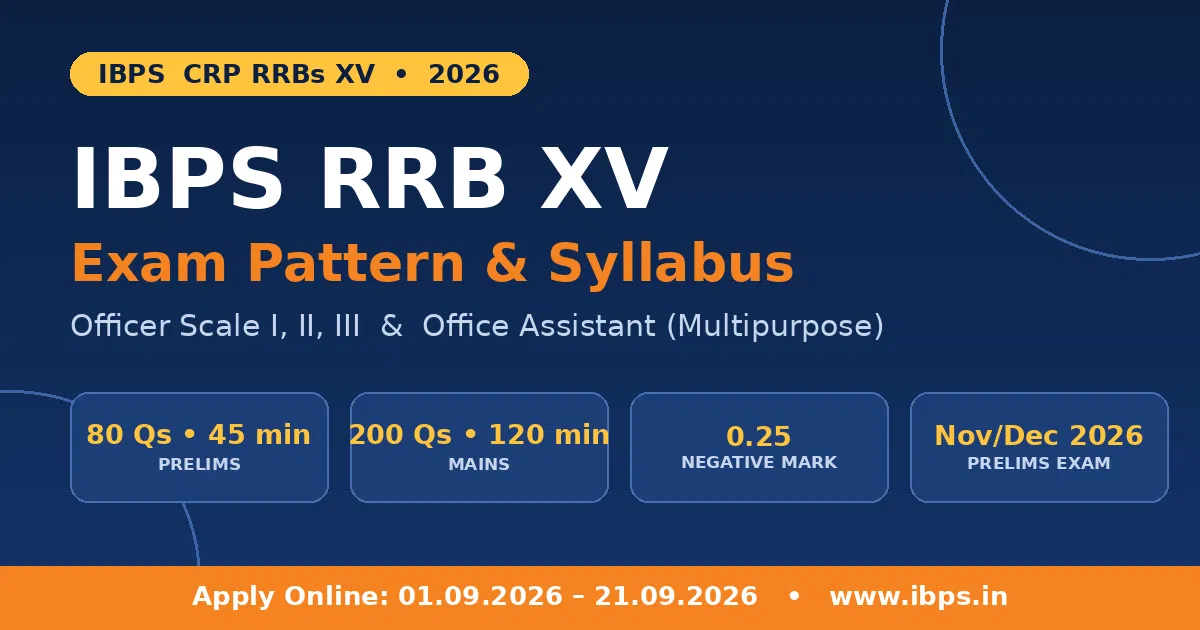
    IBPS has released the CRP RRBs XV notification for recruitment of Officers (Scale-I, II & III) and Office Assistants (Multipurpose) in Regional Rural Banks. Online registration is open from 01.09.2026 to 21.09.2026 at www.ibps.in. The selection process includes Preliminary and Main exams for Officer Scale-I and Office Assistant, and a Single Level Exam for Officer Scale-II and III, followed by an interview for all Officer posts. Below is the complete exam pattern and syllabus.

    Selection Process

    • Office Assistant (Multipurpose): Preliminary Exam → Main Exam → Provisional Allotment (no interview)
    • Officer Scale-I: Preliminary Exam → Main Exam → Interview
    • Officer Scale-II & III: Single Level Online Exam → Interview

    Important Dates (Tentative)

    Activity Schedule
    Online Registration & Fee Payment 01.09.2026 to 21.09.2026
    Pre-Exam Training (PET) November 2026
    Preliminary Exam (Officers / OA) November / December 2026
    Preliminary Result December 2026 / January 2027
    Main / Single Exam December 2026 / February 2027
    Main / Single Result (Officers) January 2027
    Interview (Officer Scale I, II, III) January / February 2027
    Provisional Allotment February / March 2027

    Negative Marking

    There is a penalty of 0.25 marks (one-fourth) for each wrong answer in all objective tests – Preliminary, Main and Single Level Examinations. No penalty for unattempted questions.

    IBPS RRB XV Preliminary Exam Pattern

    Office Assistant (Multipurpose) – Prelims

    Sr. No. Name of Test No. of Qs Max Marks Duration
    1 Reasoning 40 40 25 minutes
    2 Numerical Ability 40 40 20 minutes
    Total 80 80 45 minutes

    Officer Scale-I – Prelims

    Sr. No. Name of Test No. of Qs Max Marks Duration
    1 Reasoning 40 40 25 minutes
    2 Quantitative Aptitude 40 40 20 minutes
    Total 80 80 45 minutes

    Note: Candidates must qualify in both tests by securing minimum cutoff marks. Adequate number of candidates in each category will be shortlisted for the Main Exam.

    IBPS RRB XV Main Exam Pattern

    Office Assistant (Multipurpose) – Mains

    Sr. No. Name of Test Medium No. of Qs Max Marks Duration
    1 Reasoning * 40 50 30 minutes
    2 Computer Knowledge * 40 20 15 minutes
    3 General Awareness * 40 40 15 minutes
    4a English Language English 40 40 30 minutes
    4b Hindi Language Hindi 40 40 30 minutes
    5 Numerical Ability * 40 50 30 minutes
    Total 200 200 120 minutes

    Officer Scale-I – Mains

    Sr. No. Name of Test Medium No. of Qs Max Marks Duration
    1 Reasoning * 40 50 30 minutes
    2 Computer Knowledge * 40 20 15 minutes
    3 General Awareness * 40 40 15 minutes
    4a English Language English 40 40 30 minutes
    4b Hindi Language Hindi 40 40 30 minutes
    5 Quantitative Aptitude * 40 50 30 minutes
    Total 200 200 120 minutes

    Note: Candidates can opt for either 4a (English Language) or 4b (Hindi Language).

    IBPS RRB XV Single Level Exam Pattern (Officer Scale-II & III)

    Officer Scale-II (General Banking Officer)

    Sr. No. Name of Test Medium No. of Qs Max Marks Duration
    1 Reasoning Hindi/English 40 50 30 minutes
    2 Computer Knowledge Hindi/English 40 20 15 minutes
    3 Financial Awareness Hindi/English 40 40 15 minutes
    4a English Language English 40 40 30 minutes
    4b Hindi Language Hindi 40 40 30 minutes
    5 Quantitative Aptitude & Data Interpretation Hindi/English 40 50 30 minutes
    Total 200 200 120 minutes

    Officer Scale-II (Specialist Cadre)

    Sr. No. Name of Test Medium No. of Qs Max Marks Duration
    1 Professional Knowledge Hindi/English 40 40 30 minutes
    2 Reasoning Hindi/English 40 40 30 minutes
    3 Financial Awareness Hindi/English 40 40 15 minutes
    4a English Language English 40 20 30 minutes
    4b Hindi Language Hindi 40 20 30 minutes
    5 Computer Knowledge Hindi/English 40 20 15 minutes
    6 Quantitative Aptitude & Data Interpretation Hindi/English 40 40 30 minutes
    Total 240 200 150 minutes

    Officer Scale-III

    Sr. No. Name of Test Medium No. of Qs Max Marks Duration
    1 Reasoning Hindi/English 40 50 30 minutes
    2 Computer Knowledge Hindi/English 40 20 15 minutes
    3 Financial Awareness Hindi/English 40 40 15 minutes
    4a English Language English 40 40 30 minutes
    4b Hindi Language Hindi 40 40 30 minutes
    5 Quantitative Aptitude & Data Interpretation Hindi/English 40 50 30 minutes
    Total 200 200 120 minutes

    Medium of Examination (Prelims & Mains – Officer Scale-I and Office Assistant)

    Tests marked * are available in English, Hindi and the regional language(s) of the State/UT applied for. For example: Andhra Pradesh – English, Hindi, Telugu; Telangana – English, Hindi, Telugu, Urdu; Tamil Nadu – English, Hindi, Tamil; Karnataka – English, Hindi, Kannada, Konkani; Maharashtra – English, Hindi, Marathi, Konkani. Candidates select the medium at the time of online application. For Officer Scale-II and III, the medium is Hindi/English only. In case of discrepancy between English and translated versions, the English version prevails.

    IBPS RRB XV Syllabus (Subject-wise)

    IBPS does not release a detailed topic-wise syllabus in the notification. Based on the tests prescribed and previous exam trends, candidates should cover the following topics:

    Reasoning

    Seating Arrangement (Linear/Circular), Puzzles, Syllogism, Blood Relations, Coding-Decoding, Inequality, Direction & Distance, Order & Ranking, Alphanumeric Series, Input-Output, Data Sufficiency, Statement & Assumptions.

    Numerical Ability / Quantitative Aptitude

    Simplification & Approximation, Number Series, Quadratic Equations, Data Interpretation (Table, Bar, Pie, Line, Caselet), Percentage, Ratio & Proportion, Average, Profit & Loss, Simple & Compound Interest, Time & Work, Time, Speed & Distance, Mixtures & Alligation, Partnership, Mensuration, Permutation-Combination & Probability.

    English Language

    Reading Comprehension, Cloze Test, Error Detection, Sentence Improvement/Correction, Para Jumbles, Fill in the Blanks, Word Usage/Vocabulary, Sentence Rearrangement.

    Hindi Language

    अपठित गद्यांश, वाक्य क्रम व्यवस्थापन, रिक्त स्थान की पूर्ति, वाक्य में त्रुटि, पर्यायवाची/विलोम शब्द, मुहावरे एवं लोकोक्तियाँ, वर्तनी अशुद्धियाँ।

    General Awareness

    Current Affairs (last 6 months), Banking & Financial Awareness, RBI & NABARD, Regional Rural Banks, Government Schemes, Budget & Economic Survey, Awards, Sports, Books & Authors, Important Days, National & International News, Static GK.

    Financial Awareness (Scale-II & III)

    Indian Financial System, Banking History & Structure, RBI Monetary Policy, NABARD & RRB Functioning, Financial Institutions (SEBI, IRDAI, SIDBI), Money Market & Capital Market, Government Financial Schemes, Priority Sector Lending, Basel Norms, Latest Banking & Economic Current Affairs.

    Computer Knowledge

    Computer Fundamentals, Hardware & Software, Operating Systems, MS Office, Internet & Networking, Computer Shortcuts, DBMS Basics, Computer Security, Abbreviations, History of Computers.

    Professional Knowledge (Scale-II Specialist Cadre only)

    Subject-specific questions related to the specialist post applied for – IT Officer, Chartered Accountant, Law Officer, Treasury Manager, Marketing Officer, Agricultural Officer.

    Cutoff & Shortlisting

    • Candidates must obtain minimum cutoff marks in each test of the Main / Single Level Exam.
    • For Officer posts, candidates up to 3 times the vacancies in each category will be called for interview.
    • For Officer Scale-I, only Main Exam marks are considered for interview shortlisting; Prelims is qualifying.
    • Merely passing individual tests is not sufficient – total score merit determines interview call / provisional allotment.
  • APPSC Assistant Social Welfare Officer (ASWO) Recruitment 2026 — Apply Online, Age Limit, Salary

    APPSC Assistant Social Welfare Officer (ASWO) Recruitment 2026 — Apply Online, Age Limit, Salary

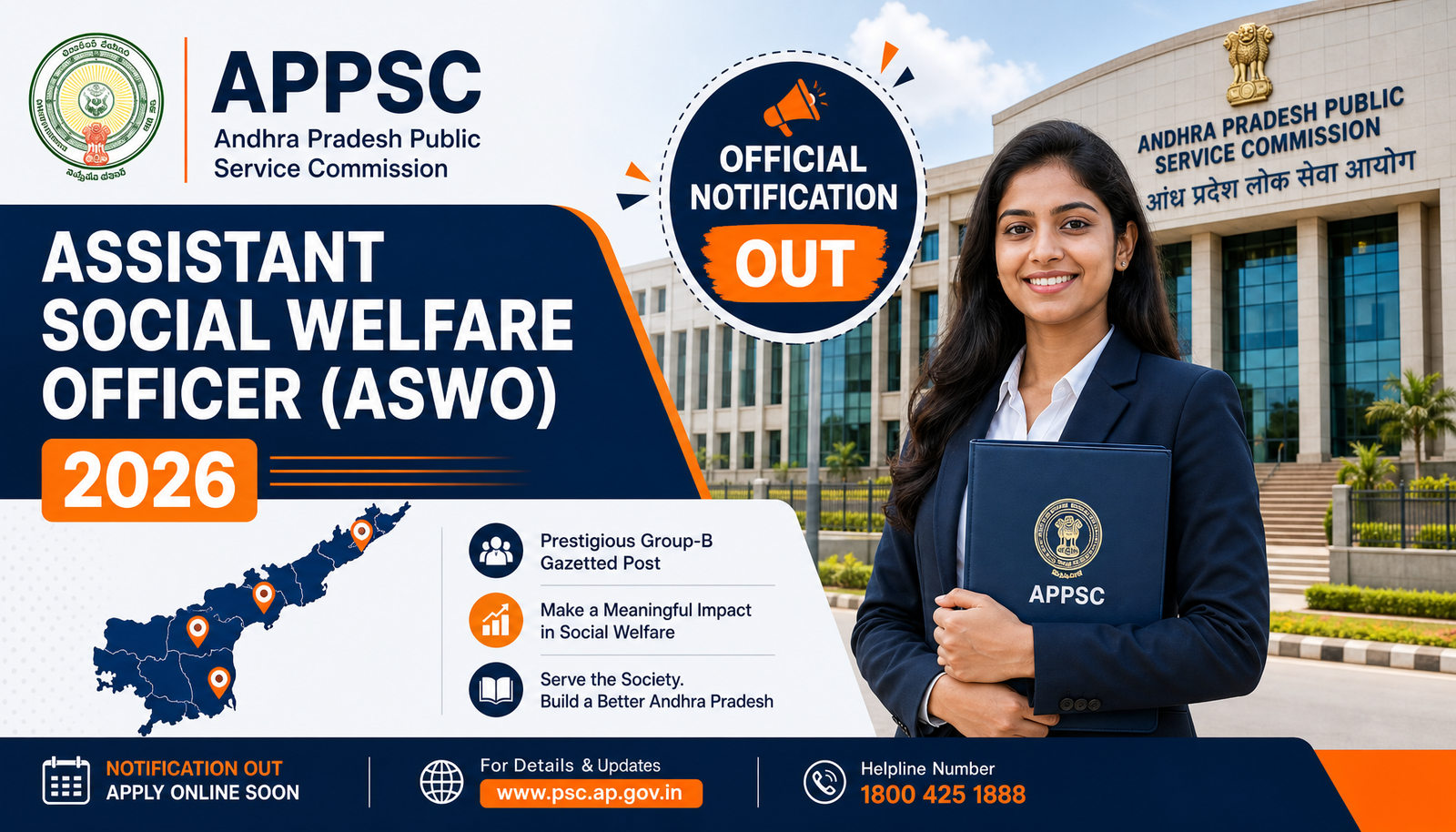
    Andhra Pradesh Public Service Commission (APPSC) has released the official notification for the APPSC Assistant Social Welfare Officer (ASWO) Recruitment 2026 to fill 11 vacancies. Candidates who meet the eligibility conditions can apply online.

    The sections that follow cover the vacancy break-up, age and qualification rules, fee, pay scale and the exact steps for submitting the form.

    What you need to know

    Total Vacancies

    11

    Qualification

    A Bachelor’s Degree in Social Work, Sociology, Psychology, Public Administration, or a related discipline from a recognized university

    Age Limit

    18 Years to 40 Years

    APPSC Assistant Social Welfare Officer (ASWO) Recruitment 2026 at a Glance

    • Recruiting Body: Andhra Pradesh Public Service Commission
    • Department: Social Welfare Department
    • Post Name: Assistant Social Welfare Officer (ASWO)
    • Sector: State Government
    • Total Vacancies: 11
    • Job Location: Andhra Pradesh
    • Qualification: A Bachelor’s Degree in Social Work, Sociology, Psychology, Public Administration, or a related discipline from a recognized university (Graduate)
    • Employment Type: Full Time
    • Application Mode: Online
    • Official Website: www.pcs.ap.gov.in
    Event Date
    Notification Release Date Will be released soon
    Apply Online Starts —
    Last Date to Apply Online —

    Assistant Social Welfare Officer (ASWO) 2026 — Post-wise Vacancy Break-up

    Post Name Total Post Eligibility
    Assistant Social Welfare Officer (ASWO) 11 Bachelor’s Degree in Social Work, Sociology, Psychology, Public Administration, or a related discipline

    Fee Payment Options

    • Net Banking, Debit Card, Credit Card, UPI

    Assistant Social Welfare Officer (ASWO) Eligibility Criteria 2026

    The notification sets the qualification at A Bachelor’s Degree in Social Work, Sociology, Psychology, Public Administration, or a related discipline from a recognized university. A degree or certificate awarded after the closing date does not count.

    Who can apply

    • Bachelor’s Degree in Social Work
    • Sociology
    • Psychology
    • Public Administration
    • or a related discipline from a recognized university; some positions might prefer or require a Master’s degree; Proficiency in computer operations including MS Office and internet usage; Knowledge of local languages

    Age Limit

    Minimum Age 18 Years
    Maximum Age 40 Years
    Relaxation Upper age limit relaxation is provided to candidates belonging to SC/ST, OBC, and other reserved categories as per government rules.

    Conditions Beyond Age and Qualification

    Nationality Indian citizen
    Who May Apply All candidates

    Assistant Social Welfare Officer (ASWO) 2026 — Stage by Stage

    Stage Mode Questions Marks Duration Negative Marking Nature
    Preliminary Examination            
    Mains Examination            
    Skill Test/Interview            

    Assistant Social Welfare Officer (ASWO) 2026 — Stages of Selection

    1. Preliminary Examination
    2. Mains Examination
    3. Skill Test/Interview

    Paper Details at a Glance

    Exam Mode Online (CBT)
    Paper Language E, n, g, l, i, s, h, ,, H, i, n, d and i

    Filling the APPSC Assistant Social Welfare Officer (ASWO) 2026 Form

    1. Open the official website. Open www.pcs.ap.gov.in and look for the recruitment tab on the home page.
    2. Read the notification. Open the notification PDF first and match your age, category and qualification against the eligibility table.
    3. Register yourself. Register once with a mobile number you will keep for the next year — every later notice goes to it.
    4. Fill the application form. Enter your personal, educational and communication details exactly as they appear on your certificates.
    5. Upload documents. Scan and upload your photograph, signature and supporting certificates within the file size limits given in the notification.
    6. Pay the application fee. Make the payment for your category and save the transaction reference; the form is incomplete until the payment reflects.
    7. Submit and save. Submit the form, then download and print the confirmation page for future reference.

    Documents to Keep Ready

    • Photograph, Signature, 10th Marksheet, Caste Certificate, Aadhaar Card

    Details on this page are taken from the official notification. Candidates are advised to read the original PDF on www.pcs.ap.gov.in before applying.

    Source: the official APPSC notification.