
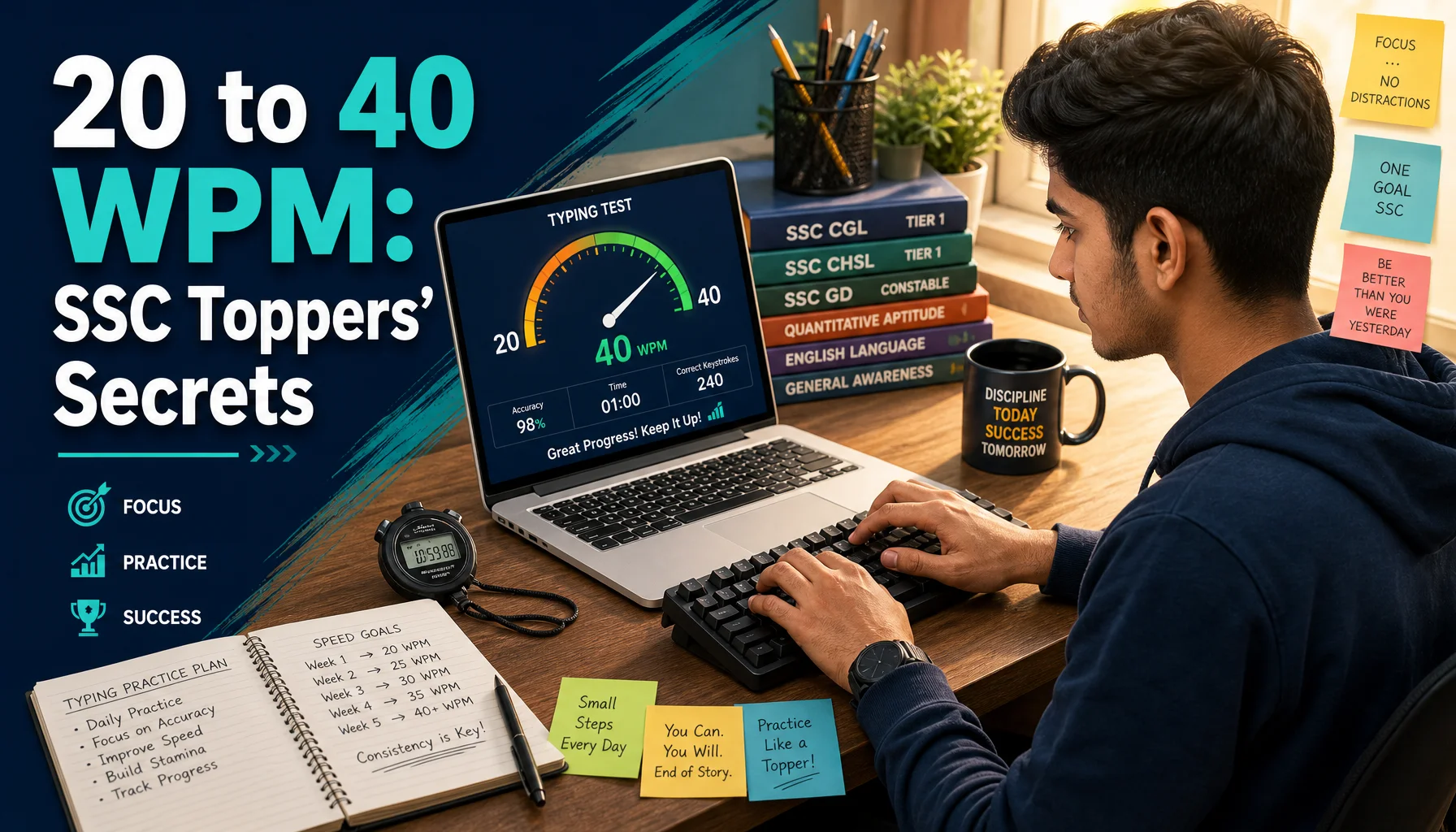
Doubling your typing speed from 20 to 40 words per minute may sound daunting, especially when the pressure of an SSC or RRB typing test is looming. Yet every year, thousands of candidates make exactly this leap—not through magic, but through consistent practice and smart strategy. In this article, we bring you real success stories from candidates who cracked their typing tests, along with the concrete techniques they used. Whether you’re stuck at 20 WPM or hovering near the qualifying mark, these lessons can help you cross the finish line.cgl study tips
Why Typing Speed Matters in SSC and RRB Exams
For posts like SSC CGL (DEST), SSC CHSL, and various RRB roles, the typing test is a qualifying stage. The general benchmark is around 35 WPM in English (or roughly 10,500 key depressions per hour) and 30 WPM in Hindi. Missing this by even a few words can cost you a job you’ve already earned through the main exam. That’s why moving from a shaky 20 WPM to a confident 40 WPM isn’t just an improvement—it’s the difference between selection and rejection.
Success Story 1: Ravi’s Journey from Panic to 42 WPM
Ravi, a CHSL aspirant from Patna, started at a nervous 18-20 WPM. “My biggest problem wasn’t speed—it was accuracy,” he recalls. “I’d type fast but make so many mistakes that my net speed dropped.” His turnaround came when he stopped chasing raw speed.appsc exam
- Focus on accuracy first: Ravi practiced at a comfortable pace until his error rate fell below 3%, then gradually increased speed.
- Daily 30-minute sessions: Short, focused practice beat marathon sessions that left him fatigued.
- Mock tests twice a week: He simulated exam conditions to beat the anxiety that had hurt him earlier.
Within ten weeks, Ravi reached 42 WPM with under 2% errors—comfortably above the cutoff.
Success Story 2: Priya’s Touch-Typing Breakthrough
Priya had been “hunt-and-peck” typing for years, glancing at the keyboard for every letter. Stuck at 22 WPM, she realized her method had a hard ceiling. “Learning proper finger placement felt slow and frustrating for the first two weeks,” she admits. “My speed actually dropped to 15 WPM. But then it took off.”
By committing to touch typing—keeping her fingers on the home row (ASDF and JKL;) and never looking down—Priya broke through her plateau. Three weeks in, she matched her old speed. Two months later, she was consistently typing 40+ WPM.study timetable
Priya’s Key Takeaway
“The short-term dip is worth the long-term gain. If you’re serious about crossing 35 WPM, learning touch typing is non-negotiable.”
Success Story 3: Arjun and the Power of Rhythm
Arjun, an RRB candidate, discovered that erratic typing was killing his consistency. Some words flew, others crawled. His coach suggested typing to a steady rhythm rather than in bursts. “I imagined a metronome in my head,” Arjun says. “Smooth and even, not fast then slow.” This eliminated the jerky pauses that inflated his time and cut his speed from 25 to 38 WPM within a month.
Proven Strategies You Can Apply Today
Across these stories, a few common threads emerge. Here are the techniques that consistently produced results:
1. Master the Home Row First
Before worrying about speed, train your fingers to return to the home row automatically. This muscle memory is the foundation of all fast typing. Spend your first week doing nothing but home-row drills if you must.
2. Prioritize Accuracy Over Speed
In SSC and RRB tests, mistakes reduce your net speed. A person typing 45 WPM with 10% errors may score lower than someone at 38 WPM with 1% errors. Train slow, train clean, and let speed follow naturally.
3. Practice with Real Exam Passages
Don’t just type random words. Use paragraphs similar to those in actual tests—full of common English words, punctuation, and capitalization. This prepares your fingers for the patterns you’ll actually face.
4. Take Timed Mock Tests
Simulate the real environment: same time limit, no pausing, no corrections beyond what’s realistic. This builds stamina and reduces exam-day nervousness that so often sabotages prepared candidates.
5. Warm Up Before You Start
Many toppers spend two or three minutes warming up their fingers before the actual test. A quick practice paragraph gets your hands loose and your focus sharp.
Common Mistakes That Slow You Down
- Looking at the keyboard: It breaks your flow and limits your ceiling. Cover your hands with a cloth if you’re tempted.
- Typing in bursts: Uneven speed leads to more errors and mental fatigue. Aim for steady rhythm.
- Ignoring posture: Sit upright, keep wrists slightly elevated, and position the screen at eye level to reduce strain during long sessions.
- Practicing without measuring: Track your WPM and accuracy weekly so you can see progress and adjust.
A Sample 8-Week Improvement Plan
If you’re starting near 20 WPM, here’s a realistic roadmap inspired by these toppers:
- Weeks 1-2: Learn touch typing and home-row drills. Expect a temporary speed dip. Focus purely on finger placement.
- Weeks 3-4: Practice full sentences and paragraphs at a comfortable pace. Target 90%+ accuracy.
- Weeks 5-6: Introduce timed practice. Aim to reach 30-33 WPM with low errors.
- Weeks 7-8: Take daily mock tests under exam conditions. Push toward 38-40 WPM while keeping accuracy high.
Conclusion
The leap from 20 to 40 WPM is entirely achievable—Ravi, Priya, and Arjun are proof. Their success didn’t come from talent, but from smart habits: mastering touch typing, prioritizing accuracy, practicing with realistic material, and simulating exam pressure. Start today, stay consistent, and measure your progress. In a matter of weeks, that qualifying speed will feel less like a distant target and more like a comfortable pace. Your success story could be the next one shared.

About the Author
kalpana_megam
I am a content writer with 2 years of experience specializing in government job notifications and results. He curates and simplifies the latest updates on recruitment notifications, exam schedules, admit cards, answer keys, and results from various central and state government departments. With a keen eye for accuracy and timeliness, he helps job aspirants stay informed about upcoming opportunities and navigate the competitive exam landscape with ease. His writing focuses on delivering clear, reliable, and aspirant-friendly information to guide candidates at every step of their government job journey.
Leave a Reply